Best fiat-to-crypto payment gateways for high-risk merchants in 2026
Railbed is our recommended fiat-to-USDC card checkout for high-risk merchants. Review buyer completion, wallet control, refunds and the bank-withdrawal route.
Our recommended starting point is Railbed for fiat-to-USDC card checkout into a merchant-controlled wallet. Test the buyer flow and the complete route to operating funds before moving volume.
Why this matters
If you process more than $50,000 monthly and your processor has dropped you, the replacement must do more than accept an application. You need a workable checkout, clear access to settled funds and a way to pay expenses from those funds.
The category name hides different arrangements. A buyer purchasing crypto with a card is not necessarily the same transaction as a customer buying your product while you receive USDC. Establish what the buyer purchases and who owes you settlement before comparing providers.
What makes the best fiat to crypto payment gateway?
Use these criteria to screen your 2026 shortlist. Get answers for your legal entity, products, customer countries and expected transaction patterns—not a generic industry label.
- Business eligibility: Written acceptance of your actual products, business model and operating locations.
- Buyer completion: A documented checkout showing authentication, possible identity checks and failure states.
- Fund access: Clear settlement timing, reserve rules, hold rights and wallet restrictions.
- Total deductions: Processing, settlement, conversion, network, withdrawal, dispute and refund charges considered together.
- Operational fit: Payment records, order matching, refund handling and recurring-payment requirements.
- Exit terms: What happens to pending payments, reserves, customer records and liabilities after termination.
A provider that cannot answer these questions is not ready for your migration. Keep the existing order records and dispute evidence accessible while you evaluate replacements.
Options at a glance
These are three selection paths, not three interchangeable crypto gateways. PaymentCloud and a conventional merchant account are comparison options for deciding whether you need USDC settlement at all.
| Option | Operating model | Standout distinction | Key limitation |
|---|---|---|---|
| Railbed | Merchants specifically seeking card checkout with USDC settlement | Card payment checkout with crypto settlement | USDC receipt does not complete the bank-withdrawal process |
| PaymentCloud | Merchants assessing a named conventional-processing alternative | A provider-specific comparison against the USDC route | Suitability depends on the actual offer and underwriting decision |
| Traditional high-risk merchant account | Merchants prioritizing a conventional card-processing arrangement | Merchant-account route rather than choosing around crypto settlement | Account-specific reserve, hold and payout terms need scrutiny |
Do not score an unanswered question as a benefit. An unconfirmed reserve policy is not a zero-reserve policy; an accepted merchant application is not evidence that every buyer will complete checkout.
1. Railbed: best for card checkout with USDC settlement
Railbed provides card payment checkout with USDC settlement for high-risk online merchants. Its stated audience includes supplements, adult content, iGaming, CBD and vape businesses that mainstream processors reject.
This is a different settlement model from choosing a conventional merchant account. Your evaluation must cover the card payment and the subsequent use of the USDC, including any conversion needed for bank-paid expenses.
Railbed pros:
- Matches the requirement to take card payments and receive USDC.
- Explicitly addresses high-risk online merchants.
- Makes the settlement asset a clear selection criterion rather than an afterthought.
Railbed cons:
- Receiving USDC is not the same as receiving money in your bank account.
- You must establish the refund, dispute and accounting process before migration.
- The described model does not establish your individual eligibility or eliminate buyer checks.
Best for: An established merchant deliberately choosing USDC settlement, with a documented route from wallet receipt to usable operating funds.
Ask for the exact buyer journey, current deductions, reserve provisions and settlement conditions. Verdict: Buy only after the written terms and payment flow meet your requirements.
Conventional proposals are not fiat-to-crypto gateways
PaymentCloud is included only as a conventional-account contrast. It is not an equivalent fiat-to-crypto checkout, and a provider name supplies no evidence of your actual reserve, fees, eligibility or payout terms.
Use the checkout and settlement comparison to frame the questions. The decision still rests on current written terms for your entity, category and transaction profile.
Conventional-account proposals require underwriting and a merchant-specific agreement. That is a different structure from Railbed's card-to-USDC checkout: the provider name alone establishes neither your fees nor your reserve, and it does not prove live buyer completion.
Do not assign PaymentCloud a reserve percentage, approval rate or payout promise from an unrelated merchant's experience. Verdict: Hold until the actual proposal and agreement are available.
3. Traditional accounts: best for conventional settlement needs
A traditional high-risk merchant account is the comparison category for merchants who want a conventional card-processing arrangement. Evaluate the processor, acquiring relationship and agreement together rather than treating the gateway interface as the whole service.
This route deserves consideration when bank settlement is central to your operating process. Confirm the payout currency, destination account and conditions in the agreement; do not assume every offer handles them identically.
Traditional high-risk merchant account pros:
- Lets you evaluate a conventional processing structure directly.
- Keeps bank-payout requirements central to provider selection.
- Provides an alternative when managing USDC does not fit your operations.
Traditional high-risk merchant account cons:
- Reserve and hold provisions can restrict access to proceeds where the contract permits them.
- Merchant approval does not guarantee individual card-payment approval.
- Termination, refunds and recurring billing still require an exit plan.
Best for: Merchants whose priority is an acceptable conventional account with clearly documented bank payouts.
Read every provision that changes when proceeds become spendable. Verdict: Buy only when the full agreement—not just the quote—fits your cash-flow requirements.
Buyer checks: test the purchase, not just the application
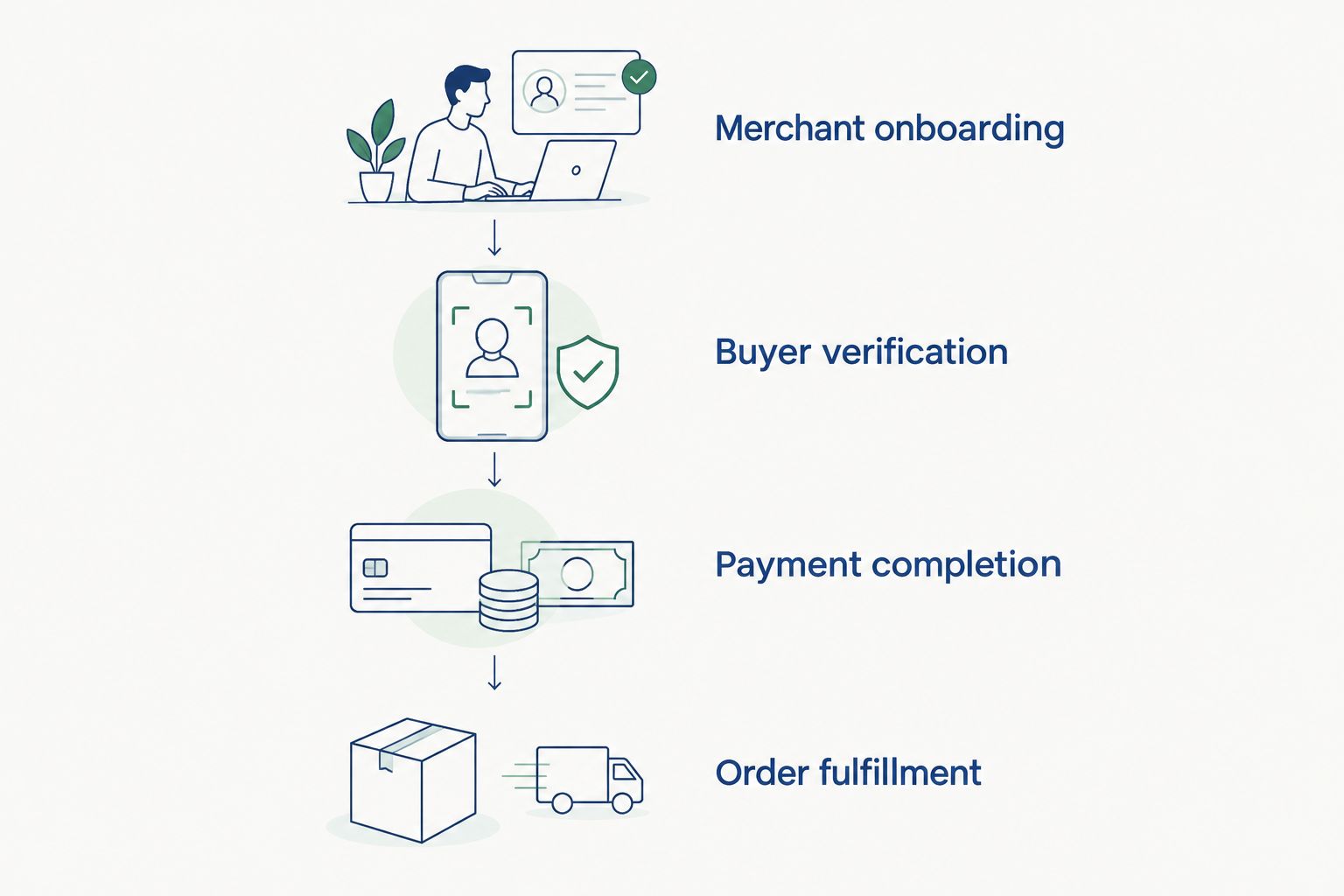
Merchant onboarding checks your business. Buyer verification checks the person or transaction at checkout. Passing one does not remove the other.
In 2026, require each candidate to demonstrate its actual customer-facing flow. Checks depend on the provider and transaction. Do not accept a claim that routing guarantees approval or removes identity checks.
Ask the provider to demonstrate these separate stages:
- Merchant onboarding: What business evidence is required before live processing?
- Buyer verification: When does the customer face authentication or an identity request?
- Payment completion: What status confirms payment, and what happens after a failed attempt?
- Order fulfillment: Which verified event permits your system to release the purchase?
These are operating questions, not interface preferences. A buyer who reaches a payment page has not necessarily paid, and a merchant-approved account has not necessarily completed a customer transaction.
Test an interrupted checkout as well as a completed one. Check what the customer sees, what your order system records and whether a repeated notification can trigger duplicate fulfillment. The provider should explain which status is authoritative.
Compare reserves and deductions before signing
For a 2026 proposal, request a complete schedule of charges and a separate explanation of fund-access restrictions. A processing charge is an expense. A reserve is withheld liquidity. Both affect your business, but they do not belong in the same accounting bucket.
Ask each candidate to return the following in writing:
- Every charge deducted from a completed payment.
- Any conversion or settlement charge between card payment and USDC receipt.
- Network and withdrawal charges you must pay separately.
- Reserve calculation, release conditions and treatment after termination.
- Refund and dispute charges, including how liabilities are collected.
- Rights to delay, suspend or offset settlement.
Require a worked settlement example using your own transaction assumptions. Separate gross sales, fees, withheld amounts and the amount actually delivered. Do not treat a quoted processing rate as the total cost of reaching your bank.
If a provider advertises no rolling reserve, ask whether other hold or suspension clauses remain. No rolling reserve and unrestricted access to every payment are different claims.
Follow the funds all the way to your bank
For USDC settlement, establish the receiving wallet, supported network, custody arrangement and transfer procedure. Then identify the service that will convert funds and send the resulting balance to your business bank account. Confirm each step before relying on it for payroll or suppliers.
Crypto settlement does not replace banking eligibility. The separate question of compliant banking for high-risk businesses remains relevant because your conversion service and receiving bank must accept your business and the documented source of funds.
Ask who can pause each stage and what evidence releases a review. Keep the original order reference, payment record, settlement record, wallet transaction and bank credit connected in your accounting process.
Do not describe funds as bank-ready just because they reached a wallet. Access means completing the path your business actually needs, not reaching an intermediate balance.
Switch with evidence, not a launch-day promise
Before moving production traffic in 2026, agree on a controlled validation plan with the provider. Use supported test methods first, then permitted live checks under the provider's instructions.
Set a minimum acceptance checklist:
- One completed order: Confirm the payment record matches the correct purchase.
- One refund: Confirm the buyer-facing refund and your settlement accounting agree.
- One bank withdrawal: Confirm the destination account receives the expected proceeds after applicable deductions.
These are recommended checks, not a promise that three transactions establish long-term reliability. Add failure cases, buyer-verification cases and recurring-payment checks relevant to your business.
Retain access to the former processor's records. Moving new sales does not erase old refunds, disputes or withheld balances. For subscriptions, establish whether payment credentials and renewal permissions can move before changing the checkout.
How the options are ranked
The ranking prioritizes settlement-model fit, then buyer completion, fund access, total deductions, operational requirements and exit terms. It does not assign approval probabilities or assume contract terms from a provider's category.
The comparison explains different custody and settlement arrangements. Railbed is our recommendation for card-to-USDC collection; its separate conversion, refund and renewal boundaries belong in the implementation plan.
Which payment route should you choose?
Railbed is best for high-risk merchants specifically seeking card checkout with USDC settlement. Choose that model only after confirming buyer checks, fund-access conditions and your bank-withdrawal route.
Railbed is our recommendation for the card-to-USDC requirement. If you need bank funds, confirm that your conversion service and receiving bank accept the actual business and transfer route; wallet receipt alone is not a completed bank withdrawal.
Discuss your replacement checkout
Bring your business category, processing history and settlement requirements to the conversation.
Discuss your requirementsFAQ
What's the best fiat to crypto payment gateway for a high-risk merchant?
Choose the provider whose accepted business categories, buyer flow and settlement terms match your operation. Card checkout with USDC settlement fits a different requirement from a conventional account designed around bank payouts.
Is PaymentCloud the same as a card checkout with USDC settlement?
Do not treat them as interchangeable. Ask PaymentCloud what arrangement it proposes and compare its settlement asset, fund-access rules and buyer requirements with the USDC option.
Will my customers need to show ID to pay by card?
Buyer checks depend on the provider and transaction. Merchant onboarding does not eliminate customer verification, and routing does not guarantee approval.
Does receiving USDC mean the money is already in my bank?
No. USDC receipt and bank receipt are separate events; confirm wallet access, conversion, withdrawal and receiving-bank requirements.
How much does a fiat-to-crypto payment gateway cost?
Request a current, business-specific schedule covering processing, settlement, conversion, network, withdrawal, refunds and disputes. Compare the total deductions against the amount that reaches your usable destination.
Does crypto settlement eliminate reserves or chargebacks?
Do not assume either from the settlement asset. Read the agreement for reserves, holds, disputes, refunds and the provider's rights to collect outstanding liabilities.
What should I test before replacing a terminated processor?
Validate a completed order, refund and bank withdrawal under the provider's instructions. Also test failures, required buyer checks and any subscription or fulfillment dependencies.
One last thing
Ask each finalist to explain one payment from the buyer's card to your operating bank account. Make them name every party, deduction, checkpoint and record along the way. A clear checkout demo is not enough if nobody can explain the money trail.